05 / Clifford attractor · generative art
One Point, One Rule
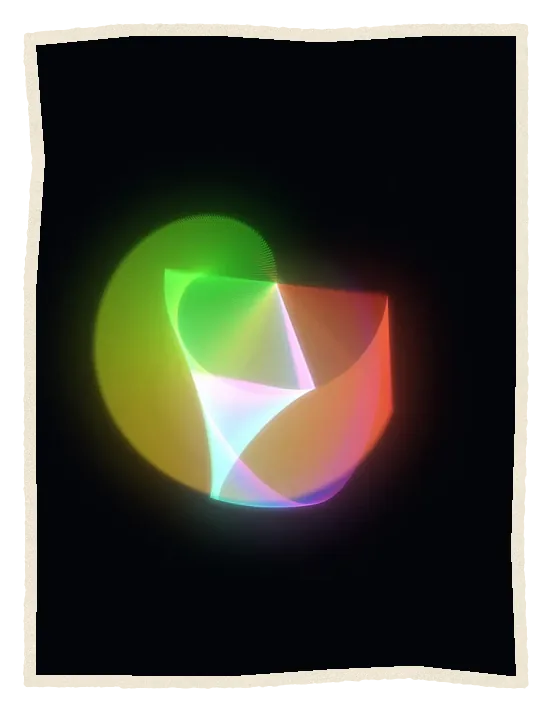
A point jumps 316 million times with the same rule, and the jumps draw a shape.
- Rule
- x′ = sin(a·y) + c·cos(a·x) y′ = sin(b·x) + d·cos(b·y)
- Points
- 316 million per frame
- Format
- 1080 × 1920 · 30 fps · 31 s
- Sound
- Synthesized from the orbit
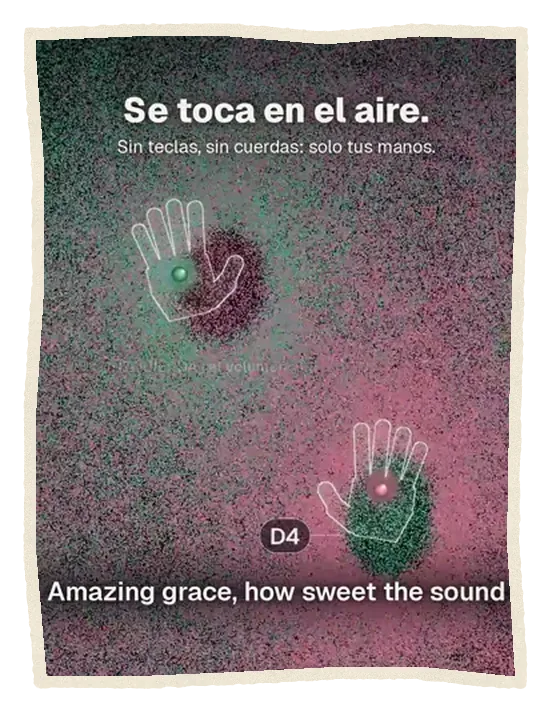
It has sound: turn it on in the video controls.
The piece
We start with a single point and apply the same rule over and over: depending on where you are, jump over there. That's it.
At first the jumps look random. But let it jump millions of times and the points don't scatter: they draw a shape, always the same one. That's chaos: a simple, exact rule with no randomness, impossible to predict step by step, that hides an order.
Then we slowly change the rule's four numbers and the shape transforms. The hard part was choosing the path: almost any route crosses zones where the drawing collapses into a handful of points. We searched for one that never leaves chaos.
Play
Move the four numbers.
Every change relaunches the point. If the drawing collapses into a few points, you fell into a periodic window: the orbit is no longer chaotic.
Color is the x each point jumped from; brightness, how many points land on each pixel.
Behind the scenes
Behind the attractor.
The reel runs at 0.6× and each layer is explained while you see it.
- 01
The rule
Every new point comes from the previous one with the same formula and four fixed numbers. Nothing is kept between frames: each one recomputes the first N points of the same orbit, so the drawing only grows, up to 316 million.
- 02
Light
While the shape changes, each frame is a fresh snapshot: 316 million points from 1024 chains with random starts. Brightness counts how many points land on each pixel, on a logarithmic scale so faint areas show too, and color shows where each point jumped from.
- 03
The route
The straight path between the four shapes collapses over 31% of the way. We tried 200,000 combinations, kept 44,468 chaotic ones and traced a loop between them, like a GPS avoiding closed roads.
- 04
Sound
Each horizontal band of the shape is a note of the chord: the more points in the band, the louder it plays.
- 05
Back to one
At the end we return to the opening orbit and draw fewer and fewer of its first points: the last to arrive leave first, until point 1 remains and the video loops back to the start.
Scope and limits
What the video claims, and what it doesn't.
- 75 short stretches of the route (4% of the way) still collapse, turn almost periodic or stick to a corner; none lasts more than a frame and the render skips them.
- For some parameters two attractors coexist. Before drawing, every chain runs a short probe and is dropped if it got trapped in the small one.
- “Chaos” is measured with a numerically estimated Lyapunov exponent (> 0.12 to accept a grid point).
- The browser demo uses far fewer points than the video (a few million) and a different tone curve.
Sources