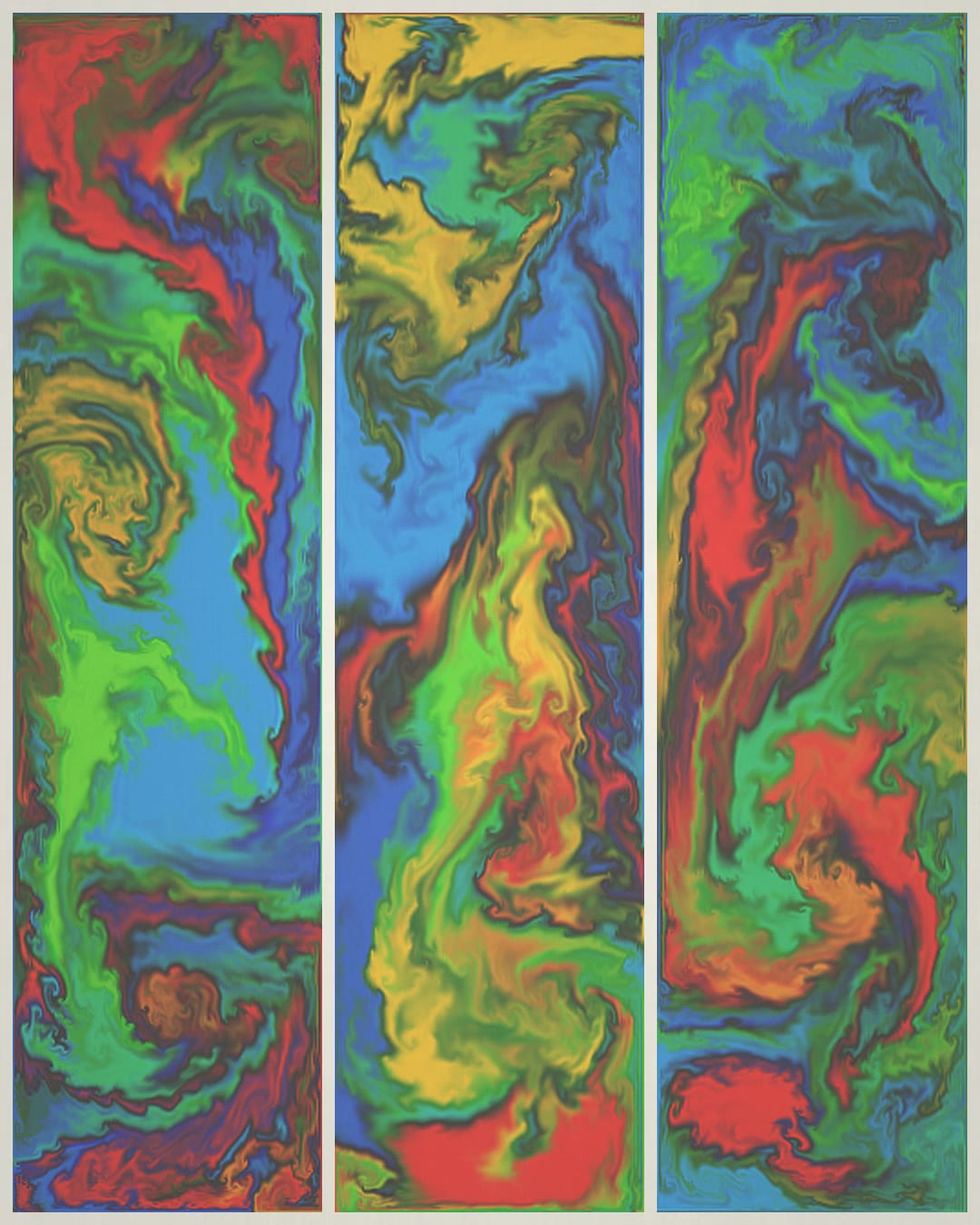
Marble.
LOTHAL STUDIO
Ink, droplets and movement calculated across a digital surface.
- Type
- Algorithmic digital artwork
- Format
- Three-panel polyptych
- Duration
- 90 seconds
- Engine
- Python / local
- Output
- 1080 × 1350 / 30 fps
- Audio
- Silent
Marble / final frame / 1080 × 1350
The artwork
Marble begins with blank paper. Drops of ink appear, spread and pull one another into veins that recall ebru, the traditional practice of marbling on water.
The image comes from neither a painting nor an AI model. Every frame is calculated by a numerical simulation written in Python and run locally with a controlled seed.
Full process
The artwork as it is generated.
The video shows all 90 seconds, from blank paper to the pigment’s final resting state.
Marble.
POLYPTYCH / 90 S / 30 FPS / SEED 23 / SILENT
The video shows all 90 seconds, from blank paper to the pigment’s final resting state.
Model
Droplets inside a velocity field.
Each event behaves like a drop, adding pigment and a small impulse to a 2D grid. A velocity field carries the ink; diffusion and visual viscosity damp its expansion while vorticity bends and stretches its edges. This is not a full physical replica of ebru, but a visual model inspired by its behaviour.
Injection
A circular source adds ink absorbance and motion at a defined position, radius and colour.
Transport
The stable-fluids method moves pigment through a 2D grid without numerical instability.
Viscosity and curl
Diffusion smooths velocity while vorticity impulses create swirls and folds between colours.
Pigment
Ink is represented as absorbance and carried by a limited MacCormack scheme that preserves crisp veins.
Paper
The system remains empty before the first drop.
Accumulation
The event rate rises and the timing of the three panels draws closer.
Climax
A radial pulse and stronger vorticity redistribute the pigment.
Rest
Velocity is damped while density and saturation finish settling.
What it simulates
Drops with visual weight, viscosity and a memory of motion.
The algorithm recreates visible relationships—expansion, drag, mixing and curl—through numerical approximations. “Physical” describes the behavioural inspiration; the artwork does not claim to predict a real bath of water, thickener and pigment.
Scope and limits
What the system claims.
- The piece uses a fluid-inspired visual simulation; it has not been calibrated or validated against a physical ebru experiment.
- Seed 23 fixes the published sequence, but exact reproduction requires the same dependency versions and compute path.
- Python, NumPy and OpenCV calculate every frame locally; no generative AI model is involved.
- Palette, rhythm, density, vorticity and composition are authored decisions embedded in the code.
References